
How to Help Your Child Practise French at Home (Even If You Don’t Speak French)
You don't need to speak French to support your child's learning. Discover simple ways to practise French at home, build vocabulary, and help your child grow in confidence, one small step at a time.
When your child comes home from school with French words to practise, you might wonder how to help if you don’t speak French yourself. You want to support their learning, but you may not know whether they are pronouncing a word correctly, remembering what they have learned, or using it in a sentence.
The good news is that you do not need to speak French to help your child build confidence in French. What matters most is creating small, positive opportunities for them to revisit what they are learning, use new vocabulary, and feel comfortable trying something unfamiliar.
For children learning Core French at school, regular practice can help make new words and expressions more familiar. It does not need to involve long worksheets or formal lessons at the kitchen table. A few minutes of meaningful practice, repeated consistently, can be a helpful place to start.
Here are some simple ways to help your child practise French at home, even if you are learning alongside them.
1. Let Your Child Show You What They Know
One of the easiest ways to practise French at home is to invite your child to teach you something they learned at school.
You might ask, “What are three French words you remember from class today?” or “Can you teach me how to say hello in French?”
Your child could demonstrate a greeting, name a few colours, count aloud, or share a new expression. If they are unsure, look at their notebook or classroom materials together and choose a few words to revisit.
This approach gives your child an opportunity to retrieve information from memory rather than simply rereading a list. It also allows you to take an active interest in their learning without needing to be the French expert.
Try to keep the conversation relaxed. If your child cannot remember a word immediately, give them time to think or look for a clue together. The goal is to encourage recall and curiosity, not to turn every interaction into a test.
2. Practise a Few Words at a Time
When children are learning French vocabulary, it can be tempting to practise an entire list in one sitting. However, a smaller selection of words can make practice feel more manageable and give your child more opportunities to use each word meaningfully.
Choose three to five words your child is currently learning. Depending on their level, these might include colours, numbers, classroom objects, animals, or family members.
You could write the French words on small cards and use them to play a quick matching game. Say a word and ask your child to find the matching picture, or show a picture and invite them to recall the French word.
You can also revisit the same words on different days rather than trying to learn everything at once. Short, repeated opportunities to remember vocabulary can help children become more familiar with what they have learned.
If you would like to make practice more engaging, use objects around your home. Ask your child to identify an item they know in French, find something of a particular colour, or count a small group of objects aloud.
The aim is not to introduce as many new words as possible. It is to help your child become more comfortable remembering and using the words they are already learning.
3. Move Beyond Memorizing Words
Remembering vocabulary is an important part of learning French, but children also need opportunities to use words in context.
For example, a child may be able to name several colours when looking at flashcards but find it more difficult to use a colour in a simple sentence. They may recognize a greeting when they hear it but hesitate when someone asks them a question.
These are different parts of language learning, and they develop with practice.
Once your child is familiar with a few words, encourage them to use those words in a short expression or sentence appropriate to their level. If they are learning colours, they might progress from naming a colour to describing an object with a model such as C’est rouge or Le livre est rouge.
You do not need to teach new grammar or correct every mistake. Instead, use examples from your child’s classroom learning and invite them to try. If they need support, provide a model they can repeat and adapt.
Over time, this kind of practice can help children begin to connect individual words with meaning and communication. The purpose of learning French is not simply to remember a vocabulary list; it is to understand and communicate using the language.
4. Listen to French Together
Children also need opportunities to hear French spoken. Listening to a short song, rhyme, story, or age-appropriate French-language clip can provide another way to revisit familiar words and expressions.
You do not have to understand every word yourself to make this worthwhile. Before listening, you might choose a simple goal, such as noticing a greeting, identifying a number, or listening for a colour your child already knows.
Afterward, ask your child what they recognized. They may remember a familiar word, identify a repeated expression, or explain what they think was happening.
Keep the activity brief and choose material that is suitable for your child’s age and current level. It is perfectly fine if they do not understand everything. Listening is also an opportunity to become more comfortable with the sound, rhythm, and patterns of French.
If your child enjoys the activity, revisit it another day. Familiarity can make it easier to notice words and expressions they missed the first time.
5. Build French Into Everyday Routines
French practice does not always need a separate time or activity. You can build small opportunities into routines you already have.
For example, you could practise a greeting at the start of the day, count a few items while tidying up, or ask your child to name familiar objects in French. If they are learning expressions for introducing themselves, you might take turns asking and answering a simple question.
The key is to connect practice to something your child has already encountered in class. You do not need to introduce new vocabulary or turn every family activity into a French lesson.
A few minutes several times a week may be more sustainable than an ambitious routine that becomes difficult to maintain. Choose an approach that fits your family, and allow your child’s interests and school learning to guide what you practise.
You can also continue reading, talking, and playing together in the language you speak at home. Supporting your child’s language development does not require you to replace your home language with French. The Toronto District School Board’s guidance for supporting French learning at home offers further ideas for families, including demonstrating interest, asking questions, playing games, and establishing manageable routines.
6. Make Mistakes Feel Like Part of Learning
Children may hesitate to speak French if they are worried about getting a word wrong or forgetting what to say. This is especially common when they are still building familiarity with the language.
Your response can help shape how they feel about practising. Instead of focusing on every error, acknowledge their effort and encourage them to try again. If they are stuck, offer a clue, repeat a model, or return to a word they already know.
For example, you might say, “You remembered the first part. Let’s look at the example together,” or “That was a good try. Would you like to practise it once more?”
It is also helpful to distinguish between a child who needs more time to recall something and a child who is repeatedly unsure how to begin. Both situations offer useful information about what kind of support might help.
Confidence does not mean a child will always know the answer. It means they are increasingly willing to participate, try, and learn from feedback.
7. Recognize When Your Child May Need More Support
Practising at home can reinforce classroom learning, but sometimes a child needs more structured opportunities to understand and use what they are learning.
You might notice that your child can repeat French vocabulary immediately after reviewing it but struggles to remember it a few days later. Perhaps they recognize words on a worksheet but find it difficult to answer a simple question, form a sentence, or use familiar expressions independently. They may also become frustrated because they are not sure how different pieces of learning fit together.
These signs do not automatically mean your child is falling behind. They may simply need more guided practice, clearer examples, or additional opportunities to revisit earlier learning before moving forward.
A helpful next step is to identify what your child can already do and where they need support. Can they recognize a word when they see it? Can they recall it without a prompt? Can they understand it in a short expression? Can they use it with some independence?
Looking at these different skills can help you move beyond the question of whether your child has memorized their French vocabulary and toward a clearer understanding of how they are developing as a language learner.
If you would like more guidance on building these skills, explore Kalvian Academy’s Year 1 and Year 2 French program, which provides structured online French learning in a small-group setting.
Small Steps Can Make French Practice More Manageable
Helping your child practise French at home does not require fluency, expensive resources, or long study sessions. Your interest, encouragement, and willingness to revisit familiar learning can help make French feel like a natural part of your child’s week.
Start with a few words, invite your child to teach you something new, listen to a short French-language resource together, or practise an expression they are learning at school. Keep the experience positive, and give your child time to build confidence through repeated opportunities to listen, understand, and communicate.
And if your child needs more than occasional practice, additional instruction can help them revisit important concepts and use French with greater confidence.
At Kalvian Academy, our French program supports young learners through structured, engaging online lessons designed to help them build vocabulary, develop communication skills, and grow in confidence.
Would you like to see whether the program is a good fit for your child? Book a free trial session and explore how small, consistent steps can support their French learning.

What to Do When Your Child Struggles With Math at Home
Your child understands Math in class, but struggles when working at home. Learn why understanding with support is different from working independently—and what parents can do to help.
There is a situation many parents recognize.
Your child comes home from school and says they understand the Math they are learning. Their teacher says they are participating. Maybe they can even explain what they did in class.
Then you sit down with them to practise at home, and suddenly the same Math feels much harder.
The hesitation starts.
“I don’t know.”
“I forgot.”
“Can you help me?”
It can be confusing, especially when you know your child understood the lesson earlier that day. But this does not necessarily mean that your child does not understand Math. Often, it means they are still learning how to use that understanding independently.
Understanding with support is different from working independently
In a classroom, students have a lot of support around them. The teacher may explain a question in a particular way. There may be examples on the board. Students can listen to other children explain their thinking. The teacher can notice when someone is confused and rephrase the question or demonstrate another strategy.
At home, much of that support disappears. Your child is looking at the question on the page and has to decide where to begin. That is a different skill.
A student might understand how to solve a problem when someone walks them through the steps, but still struggle to recognize which strategy to use when they are working independently.
That gap is important. It is also completely normal.
Before helping, give them a moment to think
When a child says, “I don't know,” our first instinct can be to jump in.
We might explain the question again, show them what to do, or remind them of the steps we think they should use.
Sometimes that is exactly what they need. But sometimes, giving them a little more time is more helpful.
Instead of immediately giving the answer, try asking:
“What do you know so far?”
“What is the question asking you to find?”
“Have you seen a problem like this before?”
“Can you show me what you tried?”
These questions shift the focus from getting the answer quickly to figuring out how to approach the problem. That is an important part of becoming an independent Math learner.
Pay attention to where the struggle happens
It is also helpful to look closely at what your child is actually finding difficult.
Are they struggling with the Math concept itself? Are they unsure which operation to use? Do they understand the calculation but struggle with word problems? Do they make small errors because they are rushing? Or do they understand the work when someone is beside them but freeze when they have to start on their own?
These are very different challenges.
A child who needs help understanding multiplication is not necessarily struggling for the same reason as a child who understands multiplication but does not know how to approach a word problem.
That distinction matters because the support should match the problem.
Don't turn homework into a battle
This is one of the biggest reasons I think it is important to be careful about how we respond when a child struggles with Math at home.
If every homework session becomes a long argument, children can quickly begin to associate Math with frustration.
The goal does not have to be finishing every question perfectly. Sometimes, it is more useful to slow down, work through one problem together, talk about the thinking behind it, and then let your child try another one independently.
Small successes matter. So does knowing when to stop.
If frustration is taking over, a short break may accomplish more than another twenty minutes of pushing through the same question.
Sometimes a child needs more opportunities to practise
Understanding a concept once does not always mean a student is ready to use it confidently in a new situation. Math builds on itself.
Students need opportunities to practise skills, make mistakes, explain their thinking, and encounter slightly different versions of the same type of problem. This is one reason consistent academic support can be helpful.
At Kalvian Academy, our Year 1 Math program is designed to give students that regular opportunity to practise and strengthen the skills they are developing in school. Through weekly online Math tutoring in a small-group setting, students can ask questions, work through problems, explain their thinking, and receive feedback as they learn.
The goal is not simply to give students another worksheet. It is to help them become more comfortable thinking through Math problems on their own.
And this applies beyond Math
The same idea comes up in language learning. A student may understand a French expression when the teacher says it in class, but hesitate when they need to produce it independently.
They may recognize vocabulary but struggle to build a sentence. They may know the answer but not feel confident enough to say it aloud. That is why practice and participation are such important parts of our Year 1 French and Year 2 French programs.
Whether a student is working on Math or French, the goal is ultimately the same: to move from “I understand this when someone helps me” toward “I can do this myself.”
What parents can do
If your child understands Math in class but struggles at home, you do not necessarily need to assume they are falling behind.
Start by asking a different question:
What part of the process is difficult for them when they are working independently?
Give them time to think. Ask questions instead of immediately giving answers. Look for patterns in the mistakes they are making. Keep practice manageable, and try not to let frustration become the main experience your child has with Math.
And if they need additional support, that is okay too. Sometimes a consistent opportunity to practise in a supportive environment is exactly what helps a student make that transition from understanding to independence.
At Kalvian Academy, our weekly online Math tutoring and French tutoring programs are designed to provide that kind of support through small-group instruction and regular practice.
If you are wondering whether additional academic support might be helpful for your child, you are welcome to try a free session and see how they respond.
Because sometimes the problem is not that a child doesn't understand. They simply need more opportunities to learn how to do it on their own.

Why “Getting Ahead” Isn’t Always the Best Back-to-School Strategy
Being ahead academically is not always the same as being prepared. Learn why strengthening foundational Math and French skills, building confidence, and practising consistently can give students a stronger start to the school year.
There is a particular kind of pressure that seems to appear every September.
The school year has barely begun, and already we are hearing about getting ahead, staying ahead, working ahead, and making sure children are prepared for what comes next.
As parents, it is understandable to want to give our children every possible advantage. We want them to feel confident. We want them to be prepared. And if there is something we can do now that might make the rest of the year easier, why wouldn’t we?
But when it comes to learning, more advanced is not always the same as more prepared.
Sometimes, the most valuable thing we can do at the beginning of a school year is not push children further ahead. It is make sure the foundation underneath them is strong.
Being ahead is not the same as being ready
Imagine a student who has started working on concepts that are several units ahead of what they are doing in class.
On paper, that may sound impressive.
But if they are still uncertain about a foundational Math skill, they may eventually find themselves struggling when that skill becomes necessary for something more complex.
The same principle applies to language learning.
A student does not necessarily become a stronger French learner by racing through increasingly advanced vocabulary or grammar. They become stronger by developing a solid understanding of the basics, becoming comfortable using the language, and having enough opportunities to practise what they have learned.
Depth matters. So does fluency. And so does confidence.
The beginning of the year is a good time to strengthen the foundation
The first few weeks of school give us an opportunity to pay attention to what students actually know and understand.
Are they comfortable with the Math skills they are expected to use? Can they explain their thinking, rather than simply produce an answer? In French, can they understand and use familiar vocabulary and sentence structures? Are they willing to participate, make mistakes, and try again?
These questions can tell us much more about a student's readiness than simply asking whether they are working above grade level.
This is one reason I believe academic support should begin with where a student actually is.
If there are gaps, we can address them. If the foundation is strong, we can extend learning thoughtfully. And if a student is ready for more challenge, there are meaningful ways to provide it without turning every academic experience into a race.
Sometimes repetition is exactly what a child needs
As adults, we can sometimes underestimate the value of practising something a child already knows.
If a student has learned a Math concept once, we may assume they should be ready to move on. But there is a difference between having seen a concept and being able to use it independently, accurately, and confidently.
The same is true in French. A student might recognize a vocabulary word when they see it on a page, but still hesitate when they need to use it in a conversation or construct a sentence independently.
That space between recognition and confident application is important.
Practice is not falling behind. Sometimes, practice is what allows a skill to become secure enough to support everything that comes next.
What if we focused on confidence instead?
One of the most important outcomes of tutoring is not simply getting a child further ahead in the curriculum. It is helping them become a more capable learner.
A student who understands why something works, feels comfortable asking questions, and knows that mistakes are part of learning is developing skills that will continue to serve them long after a particular Math unit or French vocabulary list is finished.
That is particularly important in a small-group tutoring environment.
At Kalvian Academy, our online tutoring programs are designed around regular practice, participation, and meaningful feedback. Students have an opportunity to ask questions, work through challenging concepts, and strengthen the skills they are learning in school.
For students in Year 1 Math, that might mean building confidence with foundational mathematical thinking and problem-solving.
For students in Year 1 French or Year 2 French, it might mean developing vocabulary, sentence structure, comprehension, and confidence using French.
The goal is not simply to finish the next unit first.
It is to help students build skills they can actually use.
Getting ahead can still have a place
This does not mean that enrichment or advanced learning is a bad thing.
Some students genuinely enjoy being challenged beyond what they are currently doing in school. When the foundations are secure and the additional work is appropriately matched to the student, extending their learning can be rewarding.
The important distinction is why we are moving ahead.
Is the child genuinely ready for the challenge? Are they enjoying it? Does it deepen their understanding? Or are we moving ahead simply because being ahead feels like a measure of success?
Those are very different things.
A strong start does not have to mean doing more
As we settle into another school year, I think it is worth reconsidering what we mean when we say we want our children to be “ahead.”
Maybe being ahead is not always about completing the next chapter. Maybe it is being able to approach a difficult Math problem without immediately giving up. Maybe it is feeling comfortable enough in French to raise a hand and try an answer, even when it might not be perfect. Maybe it is simply beginning the year with the confidence that I can learn this.
That is the kind of progress that can have an impact far beyond September.
At Kalvian Academy, our approach to Math tutoring and French tutoring is built around that idea. Through weekly online small-group instruction, students have a consistent opportunity to practise, strengthen their skills, and build confidence over time.
Because sometimes the best way forward is not to rush ahead.
It is to make sure the ground beneath you is strong enough to keep going.
Curious whether Kalvian Academy is a good fit for your child?
Our Year 1 Math, Year 1 French, and Year 2 French programs use weekly online small-group instruction to help students strengthen their skills, practise consistently, and build confidence throughout the school year.
Try a free session and experience a Kalvian Academy class for yourself.

How to Help Your Child Transition From Summer to School Without the Stress
The transition from summer to school does not have to be stressful. Learn how small changes to routines, learning habits, and expectations can help your child begin the school year feeling more confident and prepared.
The transition from summer to school can be a big one.
After weeks of later mornings, flexible schedules, family time, vacations, and fewer academic demands, suddenly there are alarms to set, lunches to pack, homework to remember, activities to get to, and a whole new school year to navigate.
It is completely normal for that transition to feel a little messy.
The good news is that getting back into a school routine does not have to happen overnight. In fact, trying to change everything at once can sometimes create more stress than it solves.
A smoother transition usually comes from small, consistent steps.
Start rebuilding the routine gradually
One of the simplest things families can do is begin adjusting sleep and morning routines.
If your child has been going to bed later and sleeping in throughout the summer, suddenly expecting an early bedtime the night before school can be difficult for everyone.
Instead, gradually move bedtime and wake-up time closer to the school schedule. Reintroduce the rhythm of getting dressed, eating breakfast, packing a bag, and leaving the house on time.
The goal is not perfection.
It is familiarity.
Bring back a little structure before bringing back the pressure
Summer should be a break. Children do not need to spend their final days of summer completing hours of worksheets to prepare for school.
A better approach is to gently reintroduce learning into the week.
Read together. Spend a few minutes practising Math facts. Play a word game. Review some French vocabulary. Have your child write about something they enjoyed during the summer.
These small activities can help students reconnect with academic skills without making the end of summer feel like school has already started.
For some children, this kind of gradual academic warm-up can make the first few weeks of school feel much more manageable.
Talk about school without making it a performance review
It is also worth paying attention to how we talk about the new school year.
Questions like “Are you ready?” or “You know you need to work harder this year, right?” may come from a good place, but they can unintentionally create pressure.
Try asking questions that invite conversation instead.
What are you looking forward to?
Is there anything you're nervous about?
What would help you feel more prepared?
What is one thing you want to get better at this year?
These conversations can give children an opportunity to express concerns that might otherwise show up as resistance, frustration, or anxiety.
Sometimes, simply knowing that an adult is listening can make a transition feel much easier.
Pay attention to confidence, not just performance
When school begins, it can be tempting to focus immediately on marks and results.
But in those first few weeks, I would encourage families to pay attention to something else: How does your child feel about learning?
Are they willing to ask questions?
Are they comfortable making mistakes?
Are they participating?
Are they beginning to feel confident in their new classroom?
A child may not have mastered every new concept yet, and that is okay. The beginning of the year is a time to learn, adjust, and build momentum.
If a student is struggling with Math, French, reading, or writing, noticing that early can be helpful—but the response does not need to be panic.
It can simply be support.
Keep after-school expectations realistic
September can become surprisingly busy.
Between school, sports, music, clubs, family commitments, homework, and everything else that fills a family's calendar, children can quickly feel as though there is no time to simply decompress.
Protecting some downtime is important.
A child who has had a full day of learning does not necessarily need every evening packed with additional academic work. Sometimes the most productive thing they can do is have dinner, play, read for pleasure, spend time with family, and get enough sleep.
And when additional academic support is needed, consistency matters more than intensity.
A weekly online tutoring session or small-group instruction can provide a predictable opportunity to practise skills and ask questions without adding hours of work to a student's week.
Remember that adjustment takes time
Perhaps the most important thing families can remember is that a transition is exactly that: a transition.
Some children settle into a new routine quickly. Others need a few weeks.
Some will come home excited about school. Others may be exhausted. Some may appear completely fine until they suddenly have a difficult evening.
None of this necessarily means something is wrong.
Give your child room to adjust while keeping an eye on the patterns that emerge.
If Math consistently feels overwhelming, if French participation becomes a source of frustration, or if reading and writing tasks are causing ongoing stress, that is useful information. It may be a sign that your child could benefit from some additional academic support before frustration builds.
A calmer September starts with realistic expectations
The goal of the first few weeks is not to have a perfectly organized child with perfect routines and perfect homework habits.
It is to help children gradually find their rhythm.
A little structure. A little practice. Plenty of encouragement. Enough sleep. Time to decompress. And the reassurance that they do not have to know everything right away.
At Kalvian Academy, this is one of the principles behind our approach to online tutoring and small-group learning. We want students to have a place where they can practise, ask questions, build their skills, and develop confidence without feeling like they are constantly being measured against perfection.
The transition from summer to school does not have to be stressful.
It can simply be a series of small steps toward a new routine—and a new year of learning.

The First Few Weeks Matter: Why September Is About More Than Getting Back Into Routine
The first few weeks of school are about more than getting back into a routine. They are an opportunity to build confidence, establish learning habits, identify small gaps, and create a strong foundation for the year ahead.
September has a way of making everything feel urgent.
New teachers. New classrooms. New schedules. New expectations. New extracurriculars. New routines at home.
For students, the transition from summer to school can be exciting, but it can also be a lot to take in all at once. And while getting back into a routine is certainly important, the first few weeks of school are about something much bigger: building confidence, establishing good learning habits, and creating a strong foundation for the year ahead.
As an educator and the founder of Kalvian Academy, I’ve come to appreciate just how important this period can be.
September is about finding your footing
The first few weeks are rarely an accurate reflection of what a student will be capable of by June.
Students are learning new routines, figuring out classroom expectations, adjusting to different teaching styles, and reconnecting with skills they may not have used much over the summer.
That is particularly true in subjects like Math, French, Language (reading, and writing), where new learning often builds directly on what came before.
A student who feels a little rusty in September does not necessarily need to “catch up” immediately. They may simply need time, practice, and the right support to get their footing again.
This is one reason I believe early intervention should not be about rushing students ahead. It should be about identifying where they are now and helping them build from there.
Small gaps can become bigger gaps
One of the challenges with academic learning is that small areas of uncertainty can become more noticeable as the year progresses.
In Math, for example, a student who is not completely comfortable with foundational number skills may find later concepts increasingly difficult.
In French, a student who is unsure of basic vocabulary or sentence structures may become hesitant to participate as the language becomes more complex.
And in reading and writing, a student who has difficulty organizing their ideas or understanding what they read may begin to lose confidence when expectations increase.
The earlier these areas are noticed, the easier they can often be to address.
That does not mean every student needs tutoring in September. It means September is a valuable time to pay attention.
Confidence is part of learning
One of the most important things I want students to develop is not simply the ability to complete a worksheet or get the right answer. It is the belief that they can learn something that initially feels difficult.
That confidence changes how students approach challenges.
They are more willing to ask questions. They are more likely to try again when they make a mistake. They become less afraid of getting something wrong.
This is especially important in a small-group learning environment.
At Kalvian Academy, our online tutoring sessions are intentionally designed to give students opportunities to participate, practise, ask questions, and receive guidance in a supportive setting. With small-group instruction, students can benefit from the structure of a class while still receiving meaningful individual attention.
The goal is not simply to help students “keep up.”
It is to help them feel capable.
September is a good time to establish habits
Academic success is rarely about one big moment. It is built through consistent habits.
September is an opportunity to help students establish those habits before the demands of the school year become heavier.
That might mean learning to review work regularly instead of only before a test. It might mean becoming more comfortable asking for clarification. It might mean spending a little time each week reading, practising Math, or revisiting French vocabulary.
Small, consistent actions can make a significant difference over time.
And importantly, those habits do not need to be overwhelming. A student does not need a packed schedule of extracurriculars and hours of homework to become a stronger learner.
Often, consistency matters more than intensity.
Give students room to grow
Perhaps the biggest reminder I would give families this September is this:
Your child does not need to have everything figured out in the first few weeks of school.
They are adjusting. They are learning. They are figuring out what this new year will ask of them.
Sometimes the most helpful thing we can do is give them the structure and support they need while allowing them time to grow into their new routines.
For some students, that support may come through a teacher. For others, it may be reading together at home, practising Math for a few minutes each week, or joining a French tutoring or online tutoring program that provides additional opportunities to practise.
The important thing is that support should meet the student where they are—not make them feel as though they are already behind.
September is not a race to the finish line.
It is the beginning of the foundation.
And when students start the year feeling supported, capable, and confident, they are in a much stronger position to keep learning long after the first few weeks are over.
At Kalvian Academy, that is what we hope to build: not just stronger academic skills, but stronger, more confident learners.

How to Help Your Child Start the School Year Strong
A strong start to the school year isn't about getting ahead. For students in Grades 4–8, it's about rebuilding routines, strengthening foundations, and returning to learning with confidence.
There is a particular shift that happens in the final weeks of summer.
For a while, September feels far away. Then suddenly, school supplies are being purchased, calendars are filling up, bedtime routines are starting to move earlier, and parents begin wondering whether their children are actually ready to go back to school.
It is easy to interpret “ready” as being academically ahead. Maybe your child should review more math. Maybe they should practise French. Maybe they should finish a summer workbook or start looking at material from the next grade.
Some of that preparation can certainly be helpful. But I think it is worth asking a different question:
What does it actually mean for a child to be ready to learn?
For students in Grades 4–8, a strong start to the school year is not simply about how much they remember from June. It is about whether they can return to the routines, expectations, and challenges of learning with enough confidence to engage with what comes next.
A Strong Start Begins With Routine
One of the biggest adjustments students make in September has very little to do with the curriculum.
After several weeks of summer, they are returning to a very different rhythm. They need to wake up earlier, manage a schedule, transition between subjects, listen for longer periods of time, complete assignments, and remember what they need to bring with them from one day to the next.
For some students, that transition happens fairly naturally. For others, it takes time.
That is why rebuilding routines before school begins can be just as valuable as reviewing academic content. A more consistent sleep schedule, a little daily reading, some time away from screens, and opportunities to practise focusing on one task can all help students gradually move back into the rhythm of school.
The goal is not to recreate the classroom at home.
It is simply to make the transition a little less abrupt.
Foundational Skills Still Matter
Of course, academic preparation matters too.
Students entering a new grade are going to rely on skills they developed in previous years. In Math, that might mean multiplication and division, fractions, decimals, number sense, problem-solving, or understanding how to explain their mathematical thinking. In French, students may need to draw on familiar vocabulary, sentence structures, grammar, listening skills, and the confidence to communicate.
These skills do not need to be perfect before September.
In fact, expecting students to remember everything they learned before a long summer break is unrealistic. What matters more is recognizing where the foundations are strong and where a student may need additional support.
A child who has forgotten how to approach a particular type of math problem is not necessarily “behind.” They may simply need an opportunity to reconnect with that learning.
And that distinction matters.
When we treat every forgotten skill as a problem, children can begin September already feeling as though they are struggling. When we treat it as information about what they need to revisit, we can approach learning much more constructively.
Confidence Is Part of School Readiness
There is another part of preparation that is much harder to measure but equally important: how a student feels about their ability to learn.
Students will inevitably encounter things they do not understand immediately. They will make mistakes. They will forget something they thought they knew. They will eventually come across an assignment that feels difficult.
The question is not whether those moments will happen. They will. The more important question is how a student responds when they do.
A confident learner does not necessarily think, I know how to do everything.
A confident learner is more likely to think, I don't know this yet, but I can figure out where to start.
That kind of academic confidence develops over time. It comes from having opportunities to try, make mistakes, receive feedback, revise an approach, and experience success after something initially felt difficult.
That is why I do not think preparing students for a new school year should be about removing every possible challenge before they return to the classroom.
It should be about helping them trust that they can handle those challenges.
Independence Becomes Increasingly Important in Grades 4–8
As students move through elementary school, expectations change.
A Grade 4 student may still need considerable guidance to organize their work or begin a challenging task. By Grades 7 and 8, students are increasingly expected to manage assignments, monitor their own progress, ask for clarification, and recognize when they need help.
These skills do not suddenly appear in Grade 8.
They are built gradually.
Sometimes that means resisting the temptation to immediately provide the answer when a child is stuck. Instead, we can ask, “What do you understand so far?” or “What do you think your first step should be?”
Those questions can take a little longer in the moment, but they give students something much more valuable than a completed assignment: the experience of thinking through a problem themselves.
That is the kind of independence students will continue to need as academic expectations increase.
So What Should Parents Focus On?
As September approaches, I would encourage parents to think less about whether their child has done enough and more about whether they are gradually becoming ready to learn again.
Can they settle into a routine? Are they reading and communicating regularly? Are there foundational Math or French skills that feel particularly rusty? Can they explain what they know, rather than simply produce an answer? Are they comfortable asking questions when they are unsure? Most importantly, do they believe that they are capable of learning something they do not know yet?
Those questions give us a much more useful picture of school readiness than the number of worksheets completed over the summer.
A Strong Start Is Not About Being Ahead
There will always be pressure to do more.
More review. More practice. More enrichment. More preparation.
But children do not need to walk into September having already mastered everything they will encounter during the school year.
They need strong foundations, supportive routines, opportunities to practise, and the confidence to engage with new learning.
Sometimes that means reviewing a concept that has become rusty. Sometimes it means reading a little more. Sometimes it means simply getting back into a routine and remembering what it feels like to concentrate on something for a sustained period of time.
And sometimes, it means recognizing that a child needs additional academic support before a small gap becomes a larger source of frustration.
At Kalvian Academy, this is how we think about learning. Our goal is not simply to help students get through the next assignment or prepare for the next test. Through our small-group Math and French programs for Grades 4–8, we want students to strengthen their academic foundations while developing the confidence and independence to approach learning for themselves.
Because a strong start to the school year is not about knowing everything before September begins.
It is about being ready to learn when it does.

Why Late-August Review Matters: Helping Students Transition Back to School
After eight weeks away from the classroom, students don't need more pressure—they need a gentle transition back to learning. Discover why a little late-August review can help students in Grades 4–8 reconnect with Math and French, rebuild confidence, and return to school feeling ready to learn.
There is a particular feeling that comes with the final weeks of August.
Summer is not quite over, but September is suddenly on the horizon. School supplies start appearing in stores, parents begin thinking about routines and bedtimes again, and children are reminded that the freedom of summer won't last forever.
After nearly eight weeks away from school, it is completely understandable if the idea of returning to academic routines feels a little overwhelming.
And while I don’t think children should spend all of their summer doing schoolwork, I do believe that the final weeks of August are an excellent time for a gentle academic review.
Not because children have failed to learn. Not because they need to "catch up" before September. And certainly not because summer should feel like an extension of the school year.
Rather, a little purposeful review can help students reconnect with learning before they are expected to dive back into it.
What happens to learning over a long summer break?
When a student has spent eight weeks away from the classroom, some academic skills may feel less automatic than they did in June.
This is particularly noticeable with skills that students need to retrieve quickly and repeatedly.
A child who was confidently working with fractions in June might hesitate when presented with a fraction problem in late August. A student who could conjugate familiar French verbs quite comfortably may suddenly need a moment to remember the correct ending. A student who regularly participated in class discussions might need some time to get comfortable with academic vocabulary and explaining their thinking again.
That doesn't mean the learning has disappeared. It means the student hasn't had to retrieve and use those skills regularly for several weeks. This is one reason that review is so valuable.
The purpose of review is not to reteach everything a student learned last year. It is to bring important knowledge back to the forefront so that students can access it more easily when they need it again. In other words, we are waking up the learning rather than starting from scratch.
Why this matters particularly in Math
Math is one of the clearest examples of why a little review before school begins can be beneficial.
Mathematical learning is cumulative. The concepts students encounter in one grade often depend on the foundational understanding they developed in previous years. If those foundations feel rusty, a new concept can seem much more difficult than it actually is.
For example, a student entering a new grade may need to draw on their understanding of multiplication, division, fractions, decimals, place value, measurement, patterns, or problem-solving strategies.
They may have learned all of these concepts successfully. But after eight weeks away from school, they may simply need a little practice to make those skills feel familiar again. A short back-to-school math review can provide that opportunity.
It can also give students something even more valuable: an opportunity to recognize what they do know.
When a child successfully solves a problem they haven't seen in weeks and realizes, "Oh, I remember how to do this," that small moment of recognition can make a significant difference to their confidence.
And if there is a skill they have forgotten, that is useful information too. It gives us an opportunity to address it before it becomes a barrier to new learning.
French benefits from review in a slightly different way
Language learning depends heavily on repeated exposure and use.
During the school year, students hear French regularly, encounter familiar vocabulary, practise grammatical structures, and have opportunities to speak and listen. Over the summer, that exposure often decreases considerably. As a result, students may find that their French feels a little "stuck" when they return.
They may recognize a word when they hear it but struggle to produce it themselves. They may understand a sentence but hesitate when asked to construct one. They may remember a grammatical rule but need a little prompting to apply it. Again, this is completely normal.
A Core French review before school begins gives students an opportunity to reconnect with familiar vocabulary, grammar, sentence structures, and communication skills without the pressure of learning something entirely new.
And for many students, the biggest benefit is simply hearing French again and realizing: "I actually remember more than I thought I did." That confidence matters.
Review should not become another summer burden
This is where I think balance is particularly important.
Children deserve their summer. They deserve to play, travel, read books they actually enjoy, spend time with family and friends, pursue their interests, sleep a little later, and have days that aren't structured around academic expectations.
I don't believe that an eight-week summer break needs to be filled with worksheets in order for children to remain "on track." In fact, I think the opposite can be true.
The goal of late-August review should be to make learning feel familiar again—not to make summer feel like school.
A short, focused review session can be enough to begin that transition. It gives students an opportunity to shift gradually from the rhythm of summer back into the rhythm of learning. That transition is particularly helpful for students who find changes in routine difficult, students who experience anxiety about returning to school, or students who simply need a little time to warm up academically after a long break.
Think of it as a bridge, not a head start
I think this is the most important distinction for parents to keep in mind. Late-August review isn't about getting a child ahead of their classmates. It isn't about teaching them next year's curriculum before September. And it isn't about turning the summer into a competition. It is simply about creating a bridge between where students have been and where they are going.
After eight weeks away from school, that bridge can make the first few weeks of September feel very different.
Instead of spending valuable classroom time thinking, "How do I do this again?", students may be able to think, "I've done this before. I know how to get started." That small difference can create a much more positive beginning to the school year.
So, what does an effective back-to-school review look like?
It doesn't need to be complicated.
For students in Grades 4–8, I would focus on the foundational skills that they are most likely to need as they return to the classroom. In Math, that means revisiting important concepts and problem-solving strategies rather than rushing into new content. In French, it means reconnecting with familiar vocabulary, grammar, expressions, and communication skills.
Most importantly, the experience should be low-pressure and encouraging. Students should leave thinking, "I can do this," rather than "I have so much to catch up on." That distinction is at the heart of effective back-to-school preparation.
Helping Students Start September with Confidence
At Kalvian Academy, this is exactly why we are offering our Back-to-School Review Sessions on August 25 and August 27.
These are short, focused sessions designed to help students in Grades 4–8 reconnect with their academic skills before the school year begins.
Math: 4:30–5:15 p.m.
Students will revisit important mathematical skills and problem-solving strategies in preparation for the return to school.
French: 5:30–6:15 p.m.
Students will reconnect with familiar French vocabulary, grammar, expressions, and communication skills before returning to Core French.
The goal isn't to squeeze another week of school into the end of summer. It is simply to give students a chance to pause, remember what they already know, rebuild some academic confidence, and make that first week of September feel a little more familiar.
Because after eight weeks away from the classroom, sometimes the best preparation for a new school year isn't getting ahead. It's remembering where you left off.
If you would like to register your child for one of our Back-to-School Review Sessions on August 25 or 27, please email info@kalvianacademy.com with your child's grade and the session you are interested in.
We would be happy to help your child make the transition from summer back to learning with confidence.

The Difference Between Practising and Actually Learning
Practice is important—but completing worksheets, memorizing vocabulary, or following formulas does not always mean a student has truly learned. Discover the difference between practising and applying knowledge in new situations.
As parents, it is natural to look at a completed worksheet, finished homework, or an hour spent studying and feel reassured that learning has taken place.
And sometimes, it has. Practice is an important part of learning. Students need opportunities to repeat skills, build fluency, make mistakes, receive feedback, and become more comfortable with concepts they are still developing. But there is an important distinction between practising a skill and being able to use what you have learned.
At Kalvian Academy, this is something we think about often. We want students to do more than complete a set of questions correctly. We want them to understand what they are doing, explain their thinking, and eventually use what they have learned when they encounter something new.
That is where practice becomes learning.
Practice asks, “Can you repeat this?”
Practice often involves repetition. A student may complete ten similar math questions, memorize a list of French vocabulary, practise a particular sentence structure, or work through a set of grammar exercises.
There is real value in this kind of practice. Repetition helps students develop fluency, and fluency matters. A student who is learning multiplication facts, for example, needs repeated opportunities to recall them until they become more automatic. A French learner needs repeated exposure to vocabulary and sentence structures before they can use them comfortably. A student learning to write needs practice constructing sentences and applying grammar rules.
The important question is what happens after the repetition. If a student can complete the same type of question when the steps are familiar, that tells us something. But it does not necessarily tell us whether they understand the concept well enough to recognize when and how to use it somewhere else.
That is where learning becomes deeper.
Learning asks, “Can you use this?”
A student who has truly learned something should gradually be able to take that knowledge and use it in a situation that is not exactly the same as the one they practised. They may need to apply the skill to a new problem, explain why their answer makes sense, choose a strategy independently, or connect the new idea to something they already know.
For example, a student might be able to follow a set of steps during a guided lesson. The next step is helping them recognize when those steps are useful and when another strategy might be more appropriate.
This is why I like to think about learning as moving beyond repetition. We want students to be able to apply, explain, adapt, and eventually transfer what they know. The goal is not simply to remember what they did yesterday. It is to develop enough understanding that they can use that knowledge tomorrow, even when the problem looks a little different.
French: Memorizing Vocabulary vs. Communicating
French provides a very clear example. Imagine a student has learned vocabulary for sports and activities:
le soccer, le hockey, le tennis, la musique, la lecture.
They may be able to match each French word with its English meaning or successfully complete a vocabulary worksheet. That is useful practice, and it helps build the foundation they need. But then we ask:
Qu'est-ce que tu aimes faire après l'école?
Now the student has to do something different. They need to retrieve the vocabulary, choose an appropriate verb, construct a sentence, and communicate an idea. If the conversation continues with an unexpected question, they may need to adapt again.
Can they use the vocabulary in a sentence they have not memorized? Can they respond when the question is phrased differently? Can they communicate what they mean even if they do not remember the exact model sentence from the lesson? These are important signs of learning.
The goal is not simply for a student to know that jouer means "to play." The goal is for them to be able to use jouer to communicate something meaningful.
Math: Following a Formula vs. Choosing a Strategy
Math offers another good example. A student may learn a procedure for adding decimals and practise it successfully across a page of questions. They know where to line up the decimal points, they follow the steps correctly, and they arrive at the expected answers. That practice is valuable.
But consider what happens when the student is given a real-world problem:
You have $50 to spend on a class celebration. Which combination of items can you purchase while staying within your budget? Estimate first and explain why your answer is reasonable.
Suddenly, there is no procedure written at the top of the page telling the student exactly what to do. The student has to decide which information matters, determine which mathematical operation or operations are needed, estimate the total, calculate the exact amount, and then decide whether the answer makes sense. This requires more than procedural fluency. It requires number sense and mathematical reasoning.
A strong math learner is not only someone who can follow a formula. They are also learning to recognize when a strategy is useful, why it works, and whether the result is reasonable. That is a very different kind of mathematical confidence.
English: Writing Sentences vs. Communicating an Idea
We see the same distinction in English. A student can practise writing complete sentences such as:
The dog ran across the park.
My family went to the beach.
I like reading books.
This kind of practice can help students develop sentence structure, grammar, spelling, and fluency. But writing becomes much more meaningful when students have something they actually need to communicate.
Can they explain an opinion? Can they organize their ideas so that a reader can follow them? Can they choose details that support what they are trying to say? Can they recognize when a sentence does not communicate their intended meaning and revise it?
These skills require more than producing grammatically correct sentences. They require students to understand why they are writing and to make deliberate choices about how they communicate their ideas.
So, Should Students Stop Practising?
Absolutely not. Practice matters. The goal is not to replace practice with something completely different. Rather, we want practice to be part of a larger learning process.
A student may first learn a new concept. They then need opportunities to practise it with support. As they become more comfortable, they should have opportunities to apply it in a less familiar situation. From there, we can ask them to explain their thinking and eventually transfer what they have learned to a genuinely new context.
For example:
Learn:
The student is introduced to a new mathematical concept.
Practise:
They work through similar examples and receive feedback.
Apply:
They encounter a problem where they have to decide how to use the concept.
Explain:
They describe their strategy and explain why their answer makes sense.
Transfer:
They use the same underlying idea to solve a new type of problem.
Each stage serves a purpose. The problem arises when we stop at practice and assume that successful repetition automatically means the learning is complete.
What Can Parents Look For at Home?
Parents do not need to become their child's teacher to encourage deeper learning. Sometimes, a small change in the questions we ask can give us a much better sense of what a child actually understands.
Instead of only asking: “Did you finish your homework?” you might ask: “What is one thing you understand better now?” Instead of: “How many questions did you get right?” try: “Can you show me how you know?” Instead of: “Did you memorize your French vocabulary?” try: “Can you use one of those words in your own sentence?” And instead of asking only: “Did you study for your math test?” you could ask: “How would you explain this idea to someone who doesn't understand it yet?”
These questions do not require a long lesson at the kitchen table. They simply encourage children to think about their learning rather than only the work they completed. They also give parents a valuable window into whether a child is remembering a procedure or beginning to understand the idea behind it.
The Goal Is Not Simply More Practice
As parents and educators, it is easy to focus on what we can see. We can see the completed worksheet. We can see the finished homework. We can see the vocabulary list that has been memorized. We can see the hours spent studying. Those things tell us something about a student's effort and practice, and that information matters.
But they do not always tell the whole story. Sometimes the most important evidence of learning appears when the student encounters something unfamiliar. They pause. They think about what they already know. They choose a strategy. They explain their reasoning. They make a mistake, reconsider their approach, and try again. And eventually, they say: “Oh, I understand why.”
That moment is worth more than simply getting another familiar question correct.
At Kalvian Academy, our goal is not to give students more work simply for the sake of doing more work. We want the practice they complete to help them build understanding, confidence, and independence. Because ultimately, we do not want students to become better at completing worksheets.
We want them to become better at learning.

Why Smart Students Sometimes Struggle in Math
Many capable students understand math but still struggle on assignments and tests. Discover five common reasons why—and how parents can help build stronger mathematical thinking.
Your Child Can Understand Math and Still Struggle. Here's Why.
It can be frustrating to watch a child who seems to understand math in class come home feeling discouraged by homework or tests.
Parents often tell me:
"I know my child understands the concepts, but their marks don't reflect what they know."
Or:
"They can explain it to me at home, but then they make simple mistakes on a test."
As a teacher, I have seen this happen many times.
And in many cases, it is not because a student lacks mathematical ability.
It is because understanding math and learning how to think like a mathematician are not exactly the same thing.
Strong mathematical thinking goes beyond finding the correct answer. It involves choosing strategies thoughtfully, checking whether an answer makes sense, learning from mistakes, and explaining reasoning clearly.
These are skills that take time to develop, but they are often the difference between students who feel confident in math and those who begin to doubt themselves.
Math Is About More Than Getting the Right Answer
Many students grow up believing that success in math means finishing quickly and getting the correct answer.
While accuracy is important, speed alone does not build strong mathematical understanding.
As students move into the junior and intermediate grades, teachers begin looking for something more.
They want students to explain why a strategy works, justify their reasoning, compare different approaches, and recognize when an answer does not make sense.
In other words, students are expected to think like mathematicians rather than simply follow a procedure.
When these expectations increase, some students who have always "been good at math" suddenly begin to struggle.
Not because they are less capable.
But because the way math is assessed begins to change.
Five Reasons Smart Students Struggle in Math
1. They Rush Through Problems
Many capable students work quickly because they want to finish first or because they are confident they already know what to do.
Unfortunately, rushing often leads to avoidable mistakes.
A missed negative sign.
A skipped step.
A question that was read too quickly.
Slowing down is not a sign that a student is struggling.
Often, it is a sign that they are learning to think more carefully.
2. They Don't Check Their Reasoning
Some students look only at whether they reached an answer.
Strong mathematicians also ask:
Does my answer make sense?
Could I solve this another way?
Did I answer the question that was actually being asked?
Learning to check reasoning helps students catch mistakes before someone else points them out.
More importantly, it helps them become independent learners.
3. They Rely on Memorized Steps
Memorizing procedures can be helpful, especially when students are first learning a new concept.
However, memorization has limits.
Eventually, students encounter problems that look different from the examples they have practised.
If they only remember the steps without understanding why those steps work, they often become stuck.
Students who understand the reasoning behind a strategy are much more likely to adapt when faced with unfamiliar questions.
4. They Find It Difficult to Explain Their Thinking
Have you ever asked your child how they solved a problem, only to hear:
"I just knew."
Sometimes students genuinely understand the math but have not yet developed the language to explain their thinking.
Explaining reasoning strengthens understanding.
It encourages students to organize their ideas, identify gaps in their thinking, and recognize why a strategy works.
It is also why teachers increasingly ask students to show their work or explain their solutions in writing.
5. They Give Up When the First Strategy Doesn't Work
One of the biggest differences between confident mathematicians and discouraged ones is how they respond when they become stuck.
Some students see difficulty as a sign that they are "not a math person."
Strong mathematicians see it differently.
They ask themselves:
Is there another strategy I could try?
What information do I already know?
Can I solve part of the problem first?
They understand that struggling with a problem is often part of learning, not evidence that they cannot succeed.
Helping Children Develop Mathematical Confidence
Parents sometimes ask what they can do at home to support their child's math learning.
The answer is often simpler than they expect.
Instead of focusing only on whether the answer is correct, encourage conversations about thinking.
You might ask:
How did you decide to solve it this way?
Why does your answer make sense?
Is there another strategy you could have used?
What did you learn from this mistake?
These questions shift the focus from performance to understanding.
Over time, students become more comfortable reflecting on their thinking instead of worrying about getting every question right the first time.
Strong Mathematicians Learn From Mistakes
One of the biggest misconceptions about math is that successful students rarely make mistakes.
The opposite is often true.
Strong mathematicians make mistakes, notice them, reflect on them, and learn from them.
Mistakes become opportunities to deepen understanding rather than reasons to lose confidence.
That mindset helps students become more resilient, more thoughtful, and more willing to tackle challenging problems.
Building Strong Mathematical Thinkers
At Kalvian Academy, we believe that mathematics is about much more than arriving at the correct answer.
We help students develop the habits that support long-term success: thinking critically, explaining their reasoning, checking their work carefully, and learning from mistakes.
When students understand not only what to do but also why it works, they begin to approach math with greater confidence.
Because strong mathematicians are not students who never make mistakes.
They are students who know how to learn from them.

The Hidden Skill Students Need Before High School (And It Isn’t Memorization)
High school success is not only about knowing more information. Students who thrive are those who understand how to learn, communicate, reflect, and adapt.
Many parents begin thinking about high school preparation by asking: “What does my child need to know before Grade 9?”
They may wonder, Does my child know enough math? Is their French strong enough? Are they reading at the expected level? Should they be doing more practice?
These are important questions.
Strong foundational skills matter. Students need knowledge, practice, and experience in order to build confidence and succeed academically.
However, as students move from elementary school into high school, the expectations begin to shift. Students are no longer only asked to remember information or find the correct answer. They are asked to think more deeply, explain their reasoning, and communicate their understanding.
And this is where one often overlooked skill becomes increasingly important: knowing how to learn.
Because success in high school is not only about how much information a student knows.
It is about whether they understand how to approach challenges, reflect on their learning, and adapt when something feels difficult.
The Shift From “What Is the Answer?” to “How Do You Know?”
In the early years of school, students spend a great deal of time developing foundational skills.
They learn multiplication facts, build vocabulary, practise grammar rules, develop problem-solving strategies, and learn how to organize their writing.
These skills are essential. They provide students with the foundation they need to continue growing as learners.
However, as students move into Grades 7 and 8, the questions they are asked begin to change. Instead of only asking, “What is the answer?” Teachers begin asking, “How did you get there? Why does your strategy work? What evidence supports your idea? Can you explain your thinking clearly?”
For some students, this transition can feel challenging.
They may have spent years believing that success means getting the correct answer quickly. But strong learners understand that the process matters just as much as the final answer. They know that mistakes are opportunities to learn. They know that explaining their thinking helps them understand ideas more deeply.
They know that learning is not simply about completing a task — it is about building understanding.
The Learning Habits That Help Students Thrive in High School
When families think about preparing for high school, academic content is often the first thing that comes to mind.
They may focus on:
improving math skills
reading more challenging books
practising French vocabulary
reviewing concepts from previous grades
These areas are important, but some of the skills that help students succeed in high school are not found in a textbook. They are the habits that allow students to become more independent learners.
Organization: Learning How to Manage Responsibilities
One of the biggest changes students experience in high school is the increase in independence.
Students are expected to manage multiple teachers, different assignments, longer-term projects, and greater responsibility for their own learning.
Organization is not simply about having a neat binder or keeping track of homework. It is about understanding how to manage a task from beginning to end.
Students need to learn how to ask, “What do I need to complete? When is it due? What steps do I need to take? How can I break this larger task into smaller pieces?”
When students develop these habits earlier, they often feel more confident when expectations increase.
Reflection: Understanding How They Learn
Another important skill is reflection.
Strong learners do not simply complete work and move on. They think about their learning process. They ask themselves, “What strategy helped me succeed? Where did I get stuck? What could I try differently next time? What do I understand now that I did not understand before?”
Reflection helps students become more independent because they begin to recognize that they have control over their own growth. They learn that challenges are not signs that they cannot succeed. They are opportunities to adjust, practise, and improve.
Communication: Showing What They Know
As students progress through school, they are expected to communicate their understanding in many different ways.
They may need to:
explain their mathematical reasoning
support their opinions with evidence
organize their ideas in writing
communicate effectively in another language
Knowing something is only part of the learning process. Students also need to be able to express what they know. A student who can explain their thinking is developing a skill that supports success across every subject.
How Students Can Practise These Skills Now
The good news is that students do not need to wait until high school to begin developing these habits. They can practise them through simple conversations at home.
After math, parents can ask, “How do you know your answer makes sense?”
After reading, they can ask, “What makes you think that?”
After writing, they can ask, “What message do you want your reader to understand?”
After learning something new, “What helped you understand this?”
These questions encourage students to slow down and reflect on their thinking.
Over time, these small conversations help students become more aware of themselves as learners. And when students understand how they learn, they become more confident facing new challenges.
Preparing Students for More Than the Next Grade
The goal of education is not simply to help students complete the next assignment or prepare for the next test. It is to help students become learners who can adapt, problem-solve, and continue growing.
The skills students develop before high school are the same skills they will continue using throughout their lives:
thinking critically
communicating clearly
solving problems
learning independently
having confidence in their ability to improve
At Kalvian Academy, we believe that strong learners are not created by memorizing more information. They are created by understanding how they learn. Through our small-group French and Math programs for Grades 4–8, students build academic skills while developing the confidence, communication, and learning habits that support long-term success.
Because preparing for high school is not just about knowing more.
It is about becoming ready to learn more.

What Students Actually Remember 6 Months After “Learning” Something
A strong grade does not always mean lasting understanding. Discover why students struggle to apply what they learn and how parents can help children turn knowledge into skills they can use beyond the classroom.
A student can memorize a formula, complete a worksheet, and achieve a strong grade on a test.
But six months later, can they recognize when to use that skill?
Can they apply it in a new situation?
Can they explain why it matters?
This is where true learning begins.
One of the biggest misconceptions about learning is that remembering information means a student understands it. But there is a difference between knowing an answer and knowing what to do with that knowledge.
A student may know how to calculate the area of a rectangle during a math lesson. But can they use that skill to figure out how much flooring is needed for a room?
They may memorize French vocabulary for a quiz. But can they use those words to describe their weekend, ask questions, or understand a conversation?
They may learn how to identify the main idea in a text. But can they apply that skill when reading a news article, a set of instructions, or information online?
The strongest learning happens when students have opportunities to connect knowledge to real situations.
This is why application matters.
When students use a skill in a meaningful context, they are no longer just storing information. They are building understanding.
Parents can encourage this at home through simple everyday opportunities:
Connect school concepts to daily life.
Cooking can become a math lesson through measuring, fractions, and conversions.
A grocery trip can become a lesson in budgeting, estimation, and percentages.
A family conversation can become an opportunity to practice communication skills, vocabulary, and explaining ideas clearly.
Ask, “where would we use this?”
When learning feels connected to the world around them, students begin to understand why knowledge matters.
Encourage creation, not just completion.
Instead of only answering questions, students can design, explain, compare, predict, or solve real problems using what they have learned.
The goal of education is not for students to collect information until the next test.
The goal is for them to build knowledge they can carry into new situations.
At Kalvian Academy, we believe learning becomes meaningful when students are not only able to remember concepts — but recognize when, why, and how to use them.
Because the strongest evidence of learning is not simply what a student knows.
It is what they can do with what they know.

The 5-Minute Question That Builds Stronger Learners
What if one simple question, asked for just five minutes a day, could help your child become a stronger mathematician, writer, and French communicator? Discover why "How do you know?" may be one of the most powerful questions you can ask—and how it helps students build the confidence and thinking skills they need well beyond Grade 8.
What if one simple question, asked for just five minutes a day, could help your child become a stronger mathematician, writer, and French communicator?
It is not a question that requires expensive resources, extra workbooks, or hours of studying.
It is a question that encourages something much more valuable: thinking.
The question is:
“How do you know?”
As a teacher, I have seen the difference this small question can make. It shifts students from simply searching for an answer to understanding their own learning. It encourages them to explain their reasoning, make connections, and become more confident in their abilities.
And as students move toward high school and beyond, this skill becomes increasingly important.
Because academic success is not only about knowing the answer.
It is about understanding how you got there.
The Changing Expectations Before High School
In the early years of school, students spend a great deal of time building foundational skills. They learn vocabulary, practise calculations, memorize important concepts, and develop basic writing skills.
These foundations matter.
However, as students progress through Grades 7 and 8, the expectations begin to change.
Students are asked to do more than recall information. They are expected to explain their thinking, justify their ideas, and communicate their understanding clearly.
A math teacher may ask:
“Why does your strategy work?”
A French teacher may ask:
“Can you explain your idea using complete sentences?”
An English teacher may ask:
“What evidence supports your opinion?”
The students who are prepared for these expectations are not necessarily the ones who have memorized the most information.
They are the students who have learned how to think through a problem, organize their ideas, and communicate their reasoning.
The good news is that this is a skill that can be strengthened with practice.
One Simple Habit: Encourage Your Child to Explain Their Thinking
A powerful learning habit can begin with a simple conversation.
After your child completes a problem, reads a passage, or learns something new, ask:
“How do you know?”
This question encourages students to pause and reflect.
Instead of focusing only on whether their answer is correct, they begin thinking about their process.
What strategy did they use?
Why did they make that choice?
What helped them understand?
Where did they get stuck?
These conversations help students become more independent learners because they begin to recognize that learning is not just about arriving at an answer—it is about understanding the journey.
How This Skill Supports French, Math, and English
At Kalvian Academy, we believe that strong learning skills transfer across subjects. The ability to explain your thinking is one of those skills.
French: Developing Real Communication
Learning French is not just about memorizing vocabulary and grammar rules.
Those skills are important, but the ultimate goal of language learning is communication.
A student may memorize a list of words about hobbies, activities, or daily routines. However, true language development happens when they can use those words to express their own ideas.
Instead of only asking:
“What does this word mean?”
we can ask:
“How would you use this word to share your own idea?”
This encourages students to move from remembering French to actually using French.
They begin building sentences, expressing opinions, and communicating with confidence.
Math: Understanding the Reasoning Behind the Answer
Many students believe that being successful in math means getting the correct answer.
While accuracy matters, strong mathematicians know that the thinking behind the solution is equally important.
A student who can explain:
why they chose a particular strategy
how they know their answer makes sense
where they made a mistake and how they corrected it
is developing deeper mathematical understanding.
When students practise explaining their reasoning, they become more flexible problem solvers. They learn that math is not about finding one path to the answer—it is about understanding different strategies and making sense of problems.
English: Communicating Ideas Clearly
Strong writing is not simply about completing a paragraph or meeting a word count.
Strong writing begins with clear thinking.
When students can explain what they want their reader to understand, they become better at organizing ideas, choosing evidence, and expressing their opinions.
Instead of asking:
“Did you finish your writing?”
we can ask:
“What message are you trying to communicate?”
This encourages students to see themselves as writers with ideas worth sharing.
Why This Five-Minute Habit Matters
The ability to explain thinking builds more than academic skills.
It builds confidence.
Students who practise explaining their ideas begin to trust themselves as learners. They become more comfortable asking questions, making mistakes, and trying different approaches.
It also develops critical thinking.
The world students are preparing for requires more than memorizing information. They need to analyze, problem-solve, communicate, and adapt.
Most importantly, it builds independence.
A student who understands how they learn is better equipped to face new challenges, whether that is a difficult math problem, a writing assignment, or learning a new language.
Try This Tonight
Ask your child:
“What is one thing you learned today?”
Then follow up with:
“How do you know?”
Give them time to think.
Listen to their explanation.
Ask questions that encourage them to expand their ideas.
These small conversations may seem simple, but they help students develop a habit that will support them throughout their education.
At Kalvian Academy, We Build More Than Answers
At Kalvian Academy, our goal is not simply to help students complete assignments or prepare for the next test.
We want students to become confident learners who understand how to approach challenges, communicate their ideas, and believe in their ability to grow.
Through our programs in French, Math, and English, we help students strengthen both their academic skills and the learning habits that will support them for years to come.
Because the most valuable skills students develop are the ones they carry with them long after the lesson ends.
Small habits create strong learners.
Curious how Kalvian Academy helps students become confident, independent learners?
Our small-group French and Math programs for Grades 4–8 focus on more than academic achievement—we help students develop the confidence, communication, and critical thinking skills that support lifelong learning.
Book a free trial session and discover the Kalvian difference.
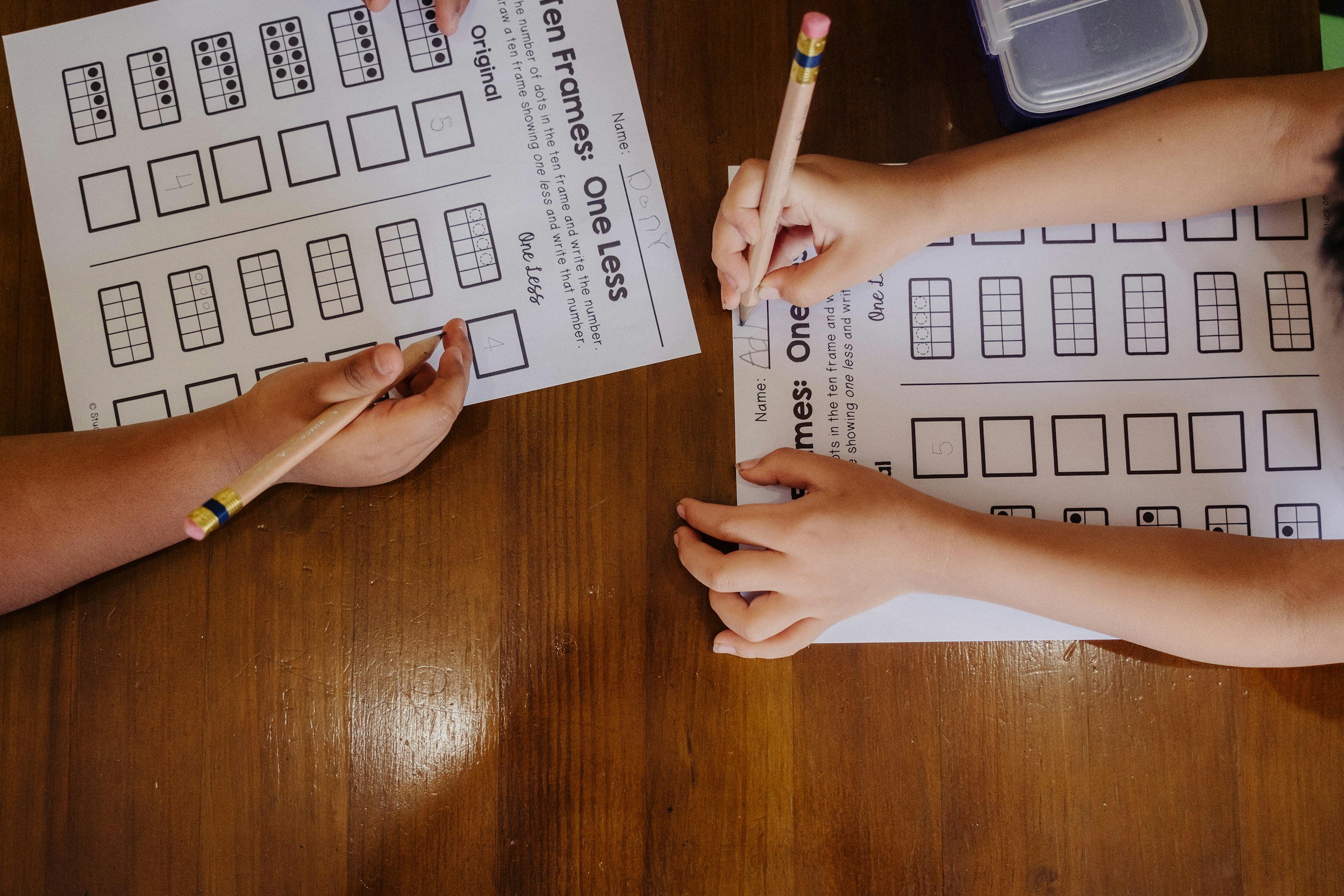
Your Child Isn’t Bad at Math — They’re Missing 3 Foundational Skills
Struggling in math is rarely about ability. More often, students are missing foundational skills that make new concepts harder to understand. In this article, discover the three most common math foundations that affect student confidence—and how consistent practice can help strengthen them.
One of the most common things I hear from parents is:
"My child just isn't a math person."
It's an understandable conclusion to reach when homework ends in frustration, test scores begin to slip, or your child starts saying they "hate math."
But after teaching students across Grades 4–8, I've noticed something important.
Most students who struggle in math aren't lacking ability.
They're missing foundational skills that were never fully developed.
Math is different from many other subjects because each new concept builds on previous learning. When a student has a gap in one area, it doesn't always become obvious right away. Sometimes they manage for months—or even years—before that missing piece starts affecting their confidence.
In many cases, what looks like a grade-level problem is actually a foundational skill that wasn't fully developed in an earlier grade. As new concepts build on old ones, those small gaps become more noticeable over time.
Here are three of the most common foundations I see.
1. Number Sense
Number sense is much more than memorizing facts.
It's the ability to understand how numbers work, recognize patterns, estimate reasonably, and think flexibly about different ways to solve a problem.
Students with strong number sense don't simply remember that 8 × 7 = 56—they understand relationships between numbers and can use those relationships to solve unfamiliar problems.
When number sense is still developing, students often:
rely heavily on memorization
struggle with mental math
find it difficult to estimate whether an answer is reasonable
become overwhelmed when numbers are presented in a different way, such as fractions or decimals
Without this foundation, math can begin to feel like a collection of rules instead of a connected system that makes sense.
2. Place Value Understanding
Place value is introduced early in elementary school, but it continues to support almost every new concept students encounter.
A solid understanding of place value helps students work confidently with:
larger numbers
decimals
multiplication and division
estimation
operations involving regrouping
When this understanding is incomplete, students may know the steps for solving a problem without fully understanding why those steps work.
That can make new learning feel inconsistent and confusing, even when they're trying their best.
3. Mathematical Language
One of the most overlooked parts of math isn't the numbers.
It's the language.
Words such as difference, product, estimate, multiple, factor, or at least all carry specific mathematical meaning.
If a student misunderstands the vocabulary in a question, they may solve the wrong problem—even if they know the math itself.
This is especially common with multi-step word problems, where students need to interpret information before deciding which mathematical strategy to use.
Building mathematical vocabulary is just as important as building calculation skills.
Looking Beyond the Marks
When students begin to struggle, it's easy to focus on the mark they received or the questions they got wrong.
Instead, it can be helpful to ask a different question:
Which foundational skill might be making this concept more difficult?
That shift moves the conversation away from labels like "good at math" or "bad at math" and toward understanding how learning develops over time.
How Kalvian Academy Supports Learning
Kalvian Academy is designed to complement—not replace—what students are learning in school.
Each week, students explore a new curriculum-aligned concept while continuing to strengthen the foundational skills that support long-term success. Our small-group sessions emphasize meaningful practice, opportunities to explain mathematical thinking, and timely feedback that helps students recognize and correct misconceptions.
A single 45-minute session each week isn't intended to replace classroom instruction. Instead, it provides consistent reinforcement and focused practice, helping students build confidence as they apply what they're learning at school.
Final Thoughts
If your child is struggling in math, try asking a different question.
Instead of asking,
"Why can't they do this?"
try asking,
"What foundation might they be missing?"
That small shift changes the conversation from blame to curiosity.
With consistent practice, thoughtful feedback, and opportunities to think through problems aloud, students can strengthen the skills that support future learning.
Strong foundations aren't built in a single lesson.
They're built one concept, one connection, and one confident step at a time.

The Emotional Labour of Teaching: Why Caring for Students Shouldn't Mean Losing Yourself
Teaching involves far more than lesson plans and report cards. Explore the hidden emotional labour of teaching and practical ways educators can stay grounded, protect their energy, and sustain meaningful careers without burning out.
Teaching has always been about more than delivering lessons.
Educators celebrate victories with students, encourage them through challenges, manage conflict, adapt constantly, and carry concerns long after the dismissal bell rings. Behind every lesson plan is emotional work that often goes unseen.
This emotional labour is one of the most rewarding aspects of teaching, but it can also be one of the most exhausting.
Over the years, I've come to realize that staying committed to students doesn't mean sacrificing ourselves in the process.
The Hidden Work That Happens Every Day
Teachers wear many hats. We teach, coach, encourage, mediate, reassure, and support.
We celebrate successes while helping students navigate disappointment. We build relationships with families. We manage changing expectations and respond to needs that extend far beyond academics.
None of these responsibilities are listed neatly in a curriculum document, yet they shape the work we do every day.
Because much of this labour is invisible, it's easy to underestimate how much energy it requires.
Caring Deeply Doesn't Mean Carrying Everything
Many educators enter the profession because they genuinely care about children. That care is one of the strengths of our profession.
But caring deeply does not mean we must carry every worry home with us.
Being invested in students and maintaining healthy boundaries are not opposing ideas. In fact, boundaries help us remain present, patient, and effective over the long term.
Teaching is a marathon, not a sprint.
What Helps Me Stay Grounded
Over time, I've learned that sustainability matters.
A few practices have made a difference:
1. Accepting That I Cannot Do Everything
There will always be another resource to create, another email to answer, and another task waiting to be completed.
Perfection isn't the goal. Consistency is.
2. Remembering That Relationships Matter More Than Perfect Lessons
Students rarely remember every worksheet.
They remember how they felt in our classrooms.
Connection often matters more than complexity.
3. Protecting Time Outside of School
Rest isn't something that needs to be earned.
Spending time with family, pursuing interests, and disconnecting from work are investments that help educators return with renewed energy.
4. Leaning on Community
Teaching can feel isolating, but it was never meant to be done alone.
Conversations with colleagues, mentors, and other educators remind us that we're not carrying these experiences by ourselves.
A Sustainable Career Matters
The goal isn't to care less.
The goal is to care in a way that allows us to continue doing this work with joy, purpose, and perspective.
Students benefit most from educators who are grounded, supported, and able to bring their whole selves into the classroom—not from teachers who are constantly running on empty.
Teaching asks a great deal of us.
But caring for ourselves isn't separate from caring for students.
It's part of it.
The Case for Slow Learning in a Fast World
In a fast-paced education system, it is easy to equate speed with success. This article explores why slow learning—rooted in depth, repetition, and reflection—creates stronger, more confident, and more independent learners over time.
Why depth, repetition, and reflection matter more than speed, and how we can design learning that actually lasts
We are living in a time where speed is often mistaken for progress.
Children are encouraged—sometimes implicitly, sometimes directly—to move quickly through content, finish first, and “keep up.” In many learning environments, there is a quiet pressure to cover more, move faster, and demonstrate progress in ways that are immediately visible.
But learning does not actually work at the speed of performance.
It works at the speed of understanding.
And understanding takes time.
At Kalvian Academy, we think a lot about this tension between speed and depth—especially when working with students in Grades 4–8, who are building the foundational thinking habits that will shape how they learn for years to come.
What we’ve found is simple, but often overlooked: When students are rushed, they perform. When students are given time, they learn.
And those are not the same thing.
Why fast learning feels successful—but often isn’t
Fast learning is rewarding in the short term. Students complete tasks quickly, feel a sense of accomplishment, and often receive external validation for being “ahead” or “on track.”
But speed can quietly mask gaps in understanding.
A student may be able to solve a problem today, but struggle to apply the same concept in a slightly different context tomorrow. They may remember steps without understanding why those steps work. They may appear confident, but feel uncertain when the structure changes even slightly.
This is not a sign of weakness. It is a sign that learning has not had enough time to settle.
True understanding requires more than exposure. It requires processing, revisiting, and connecting ideas over time.
The role of repetition: building memory that lasts
Repetition is often misunderstood as “doing the same thing again.” In reality, effective repetition is about returning to ideas in slightly different ways, at spaced intervals, with increasing independence.
When students revisit concepts, something important happens: their thinking becomes more automatic, but also more flexible. They are no longer trying to remember what to do step-by-step—they begin to recognize patterns, relationships, and structures.
This is where confidence grows.
Not from getting it right once, but from recognizing, “I’ve seen this before, and I can figure it out again.”
Repetition builds familiarity. Familiarity builds confidence. Confidence builds independence.
Reflection: the step that is most often skipped
In many learning environments, reflection is the first thing to go when time is tight.
But reflection is where learning actually consolidates.
When students are given space to think about what they did, what worked, what didn’t, and why, they begin to develop metacognition—the ability to understand their own thinking process.
This is one of the strongest predictors of long-term academic success.
A student who can reflect does not just complete tasks. They improve over time.
They begin to notice patterns in their mistakes. They adjust strategies. They become less dependent on external correction and more capable of self-correction.
Reflection turns experience into growth.
Designing for slow learning in a fast system
The challenge, of course, is that most systems are not designed for slowness.
Curricula are packed. Timelines are tight. Expectations move forward whether understanding is ready or not.
So the question becomes: how do we design learning that honours depth within real constraints?
It starts with intention.
Slow learning does not mean moving aimlessly or reducing expectations. It means being deliberate about how we structure time and cognitive load.
It means prioritizing fewer concepts, taught well, rather than many concepts, touched briefly.
It means building in planned review, not as an afterthought, but as part of the core learning process.
It means allowing students to sit with ideas long enough that they become part of their thinking—not just their short-term memory.
And perhaps most importantly, it means resisting the pressure to equate speed with success.
What this looks like for students
When slow learning is done well, the shift is subtle but powerful.
Students stop rushing to finish first and start focusing on understanding.
They become more willing to revisit mistakes instead of moving past them quickly.
They begin to recognize that not knowing immediately is not a problem—it is part of learning.
And over time, something even more important happens:
They start trusting that they can figure things out, even when it takes time.
That trust is what carries them forward in more complex academic work later on.
Final reflection
In a fast-moving world, slow learning can feel countercultural.
But education is not about keeping pace with urgency. It is about building thinking that lasts.
Depth, repetition, and reflection are not “extra” parts of learning. They are the conditions that make learning real.
When we give students time to think more carefully, revisit ideas more than once, and reflect on their process, we are not slowing them down.
We are giving their learning somewhere to stay.
Teaching Resilience Through Academic Struggle — Not Avoiding It
True academic resilience is not developed by avoiding difficulty, but by guiding students through it. This article explores how structured, supported struggle helps Grades 4–8 learners build confidence, independence, and long-term success in and beyond the classroom.
In both classrooms and homes, there is a very natural instinct to protect children from frustration. We want learning to feel positive, encouraging, and successful. As educators and parents, it can feel uncomfortable to watch a child struggle with a concept, sit in confusion, or make repeated mistakes.
But one of the most important truths in education is this: resilience is not built when learning is easy. It is built when students are given the opportunity to work through difficulty in a supported and intentional way.
For students in Grades 4–8, this stage is especially important. They are developing not only academic skills, but also the habits of mind that will carry into high school and beyond—how they respond to challenge, how they recover from mistakes, and how they see themselves as learners.
At Kalvian Academy, we often think about this balance carefully. We do not aim to overwhelm students or let them sit in frustration without support. Instead, we design learning experiences that include what we call “safe struggle”—moments where students are challenged, but always within a structure that allows them to succeed with guidance.
Because the goal is not to remove difficulty. The goal is to make students stronger within it.
Why avoiding struggle can actually hold students back
When students are constantly shielded from challenging moments—when they are quickly given answers, redirected away from difficult questions, or moved forward before they have had time to think—learning can appear smooth in the moment. They may complete tasks accurately and feel successful.
However, over time, this can lead to patterns that become harder to shift later on. Students may begin to doubt themselves when they are not immediately successful. They may become anxious when faced with unfamiliar tasks. Some begin to avoid challenging work altogether, preferring tasks they already know they can do. Others develop a quiet dependence on adults to confirm every step.
These responses are not signs of inability. They are often signs that students have had fewer opportunities to sit with productive struggle and work their way through it.
And that skill—learning how to stay with difficulty—is essential for long-term academic confidence.
What “safe failure” really means in practice
It is important to clarify that when we talk about letting students “fail safely,” we are not talking about leaving them unsupported or allowing frustration to build unchecked. Safe failure is structured, intentional, and carefully designed.
It means students are placed in learning situations where the task is appropriately challenging, but still achievable with effort and guidance. It means mistakes are treated as part of the learning process, not as final judgments. It also means feedback is timely and specific, so students understand not only what went wrong, but how to move forward.
Most importantly, it means students are never alone in their struggle. The teacher remains present as a guide, helping them reflect, adjust, and try again without removing the thinking responsibility from them too quickly.
When done well, safe failure creates an environment where students can take academic risks without fear, which is where real growth begins.
How we can build productive struggle into learning
There are many simple but powerful ways to build resilience into everyday learning experiences, both in classrooms and at home.
One approach is allowing a little more thinking time before stepping in to help. When students are given space to attempt a problem first, even if they are unsure, they begin to develop independence and confidence in their own reasoning. A well-timed question such as “What do you notice?” or “What could be your first step?” can be more powerful than immediately correcting an error.
Another important shift is helping students understand that first attempts are not final answers. Many students believe that their first response reflects their ability, when in reality, it is simply the starting point of their thinking process. When we normalize revision and rethinking, we help students separate their identity from their mistakes.
It is also valuable to create opportunities where mistakes carry no formal weight. Practice work, drafts, and low-stakes activities allow students to experiment without fear of consequence. These spaces are often where the deepest learning happens, because students are more willing to take risks.
Finally, one of the most important skills we can teach is how to recover from mistakes. Not just correcting them, but understanding them—recognizing what went wrong, adjusting thinking, and trying again with new insight. This is where resilience truly develops.
What parents often worry about
It is very common for parents to ask whether struggle means their child is falling behind. That concern is understandable, especially in a system that often equates speed and ease with success.
But struggle, when supported appropriately, is not a sign of failure. In many cases, it is a sign that learning is actively taking place.
The real concern is not whether a child is struggling. It is whether they are learning how to work through that struggle, or whether they are being moved past it too quickly.
When students avoid challenge altogether, or rely heavily on reassurance, they may appear successful in the short term, but later find it difficult to manage more complex academic demands independently.
The long-term goal: confident, independent learners
By the time students reach Grades 7 and 8, academic expectations increase significantly. They are expected to manage more abstract thinking, longer assignments, and greater independence across subjects.
If students have not had the chance to build resilience earlier on, this transition can feel overwhelming.
But when students have been gradually and safely exposed to productive struggle, something meaningful shifts. They begin to approach challenges with more calm. They are more willing to try before asking for help. They recover more quickly when they make mistakes.
Most importantly, they start to trust their own thinking.
And that confidence becomes the foundation for long-term academic success.
Final reflection
As educators and parents, our role is not to remove difficulty from learning. It is to make difficulty safe, supported, and meaningful.
When students are given the chance to struggle in the right way, they do not become discouraged. They become stronger.
At Kalvian Academy, this is at the heart of how we design learning every week: structured support, thoughtful challenge, and space for students to grow into resilient learners who are not afraid of complexity.
Because in the end, the ability to stay with a problem—and work through it—is one of the most valuable skills a student can develop.

Parent-Teacher Collaboration Strategies That Actually Work
Practical parent-teacher collaboration strategies to support learning at home, understand curriculum pacing, and improve education communication beyond grades.
When we think about school success, we often default to one metric: grades.
But in reality, grades are just the outcome. The real drivers are what happens long before the report card ever arrives—clear expectations, consistent communication, and aligned support between home and school.
And at the centre of that? Parent-teacher collaboration.
In my experience working with students across Grades 4–8, the most meaningful progress happens when parents and teachers are not operating in parallel—but in partnership.
Not in a formal, overwhelming way. But in small, intentional conversations that focus on learning, not just results.
Here are practical, realistic ways parents can strengthen communication with teachers in a way that actually supports student learning at home.
1. Go Beyond “How is my child doing?”
This is often the first question parents ask, but it’s also the least specific.
Instead, try:
“What are students currently working on in this unit?”
“What skills are being emphasized right now?”
“Where do most students typically struggle in this topic?”
This shifts the conversation from performance to process—and gives you something actionable to support at home.
2. Understand the Rhythm of the Curriculum
One of the biggest gaps I see is between curriculum pacing and parental awareness.
Teachers often move through units in structured timelines, but families don’t always have visibility into that progression.
Ask:
“What is the pacing for this unit?”
“When should I expect major assessments or milestones?”
“What foundational skills should be secure before the next topic?”
When parents understand pacing, support at home becomes far more targeted and less stressful.
3. Clarify Homework Expectations (Not Just Completion)
Homework is often misunderstood as “finish the worksheet.”
But in most classrooms, it’s meant to reinforce specific skills—not just check completion boxes.
Helpful questions include:
“What is the purpose of homework in this unit?”
“How long should this realistically take?”
“What does success look like beyond correctness?”
This helps parents shift from correcting answers to reinforcing learning habits.
4. Align on Learning Goals, Not Just Grades
Grades tell you where a student ended up. Learning goals tell you where they are going.
Ask teachers:
“What are the key learning goals for this term?”
“Which skills are most important for long-term success?”
“What does progress look like at this stage?”
When parents understand the destination, they can better support the journey.
5. Keep Communication Consistent—but Light
Parent-teacher collaboration doesn’t need to be constant to be effective.
A few well-timed check-ins across a term can be more impactful than frequent reactive messaging.
Think:
Early unit check-in
Mid-unit progress understanding
Pre-assessment clarity
Consistency matters more than volume.
Final Thoughts
Strong student outcomes are rarely the result of one environment working perfectly.
They come from alignment between home and school—where both sides understand not just what is being learned, but how and why it’s being taught.
When parents and teachers collaborate around learning (not just grades), students feel that consistency everywhere they go.
And that’s where real confidence in learning starts.

Language Is More Than Words: Why Culture Makes French Stick
Language is often taught as grammar rules and vocabulary lists, but real understanding comes through culture. When music, stories, and real-world context are woven into French learning, students move beyond memorization and begin to build lasting understanding, confidence, and connection with the language.
In many classrooms, French is taught as a system of rules.
Students learn vocabulary lists, practice grammar structures, and complete exercises designed to reinforce accuracy. These are important parts of learning a language, but on their own, they often don’t lead to long-term understanding.
Because language is not just something to be memorized. It is something that is lived.
It is shaped by people, culture, and context. And when those elements are missing, language can feel disconnected from anything meaningful.
Students may be able to complete assignments correctly, but still struggle to truly retain or use what they’ve learned outside of the classroom.
When we think about how language is naturally acquired, it is rarely through isolated vocabulary or grammar drills.
It happens through exposure. Through stories. Through rhythm and repetition. Through seeing language used in real, human contexts.
Without culture, French can start to feel like an abstract subject rather than a living language.
And when that happens, students often rely on short-term memorization rather than genuine understanding.
It’s not that they aren’t capable of learning the language—it’s that the learning experience is incomplete.
When cultural elements are brought into language learning, the experience shifts in subtle but important ways.
Music, for example, allows students to hear how language naturally flows. Over time, they begin to absorb patterns without even realizing it.
Stories give language meaning. They provide context, emotion, and structure that help students understand how ideas connect.
And cultural touchpoints—whether it’s a festival like La Fête de la Musique or traditions connected to Bastille Day—help students see that language exists within a real world, not just a worksheet.
These moments make French feel more grounded, more relevant, and ultimately more memorable.
One of the most noticeable differences in culturally connected learning is engagement.
Students tend to participate more willingly when they feel some sense of connection to what they are learning. They take more risks with speaking. They become more curious about meaning.
And perhaps most importantly, they begin to see language as something they are capable of using, not just studying.
This is not about making lessons more entertaining. It’s about making them more meaningful.
When students encounter language through cultural context, retention naturally improves.
A phrase connected to a story or a shared classroom experience is far more likely to stay with them than something learned in isolation.
Over time, this builds confidence. Students begin to recognize patterns, make connections, and rely less on memorization.
They start to trust their understanding.
And that shift—from memorizing to understanding—is where real progress happens.
In larger classrooms, it can be difficult to consistently bring culture into language learning in a meaningful way.
There are time constraints, curriculum pressures, and a wide range of student needs to balance.
In smaller group settings, there is more space to slow down, explore ideas, and connect language to experience.
Students are not just moving through content—they are engaging with it.
At Kalvian Academy, this is intentional. Language and culture are not treated separately. They are woven together so that students are not just learning French, but experiencing it in a way that feels natural and lasting.
Language and culture are not separate ideas.
They are deeply connected, and when they are taught together, learning becomes more than academic performance.
It becomes understanding.
And that is what allows language to stay with students long after the lesson ends.

The Missing Link in School Assessments: Using Feedback for Real Growth
Most students receive grades—but not the kind of feedback that actually helps them improve. This article breaks down the difference between formative and summative assessment, explains why progress often stalls after evaluation, and explores how targeted, specific feedback can transform student learning. It also highlights why small-group learning environments—like those at Kalvian Academy—create the conditions needed for meaningful, sustained academic growth.
In most classrooms, students are constantly assessed—but not always truly supported in their learning journey.
They receive tests, quizzes, assignments, and report cards. They see numbers, levels, and letter grades. But what many students don’t consistently receive is the one thing that actually drives improvement: clear, actionable feedback.
To understand why this matters, we need to look at the difference between two types of assessment: formative and summative.
Formative vs Summative Assessment: What’s the Difference?
Summative assessment happens at the end of learning.
It’s the test after the unit, the final essay, the exam at the end of a term. Its purpose is to evaluate what a student has learned. It answers the question:
“What did the student achieve?”
While important, summative assessment is largely reflective—it tells us the outcome, not the next step.
Formative assessment, on the other hand, happens during learning.
It includes conversations, drafts, in-class practice, quick checks for understanding, and ongoing observation. Its purpose is to guide improvement in real time. It answers:
“How can the student improve from here?”
This is where real learning acceleration happens—but only when it is used effectively.
Why Students Often Don’t Improve (Even When They Try)
A common misconception in education is that effort alone leads to improvement. But in reality, many students work hard without making meaningful progress.
Why?
Because they often receive:
Grades without explanations
General comments like “good work” or “needs improvement”
Feedback that comes too late to act on
Too little guidance on how to improve
In other words, they know where they are—but not how to move forward.
Without clear direction, students tend to repeat the same mistakes, even when they are motivated to improve. This is not a motivation problem—it’s a feedback problem.
What Effective Feedback Actually Looks Like
Effective feedback is:
Specific (not general)
Actionable (students know what to do next)
Timely (given while learning is still happening)
Focused (prioritizes one or two key improvements, not everything at once)
For example, instead of saying:
“Your paragraph needs work,”
Effective feedback sounds like:
“Your main idea is clear, but each supporting sentence should connect back to your topic sentence. Try starting each sentence by linking it explicitly to your argument.”
This kind of feedback changes behaviour—not just understanding.
It teaches students how to think, not just what they got wrong.
Feedback as a Driver of Student Growth
When feedback is consistent and targeted, students begin to:
Recognize their own patterns of error
Self-correct more independently
Build confidence through small, visible improvements
Develop stronger long-term academic habits
Over time, learning shifts from performance-based (“Did I get it right?”) to growth-based (“How can I improve this?”).
This shift is what separates struggling students from steadily improving ones.
Why Small-Group Learning Changes Everything
One of the biggest challenges in traditional classrooms is scale.
Teachers are often responsible for 25–30 students at once. Even with strong instructional practice, it becomes difficult to give each student detailed, personalized feedback consistently.
This is where learning environments make a significant difference.
In small-group settings, feedback becomes:
More frequent
More specific
More individualized
More immediately usable
Students are not just part of a group—they are actively seen, heard, and guided through their thinking process.
This is one of the core reasons why structured small-group tutoring can accelerate learning in ways that whole-class instruction often cannot.
At Kalvian Academy, this is intentional. Our model is built around focused group learning where feedback is not an afterthought—it is embedded into every session. Students don’t just complete work; they refine it in real time with guidance that helps them grow steadily and confidently.
Final Thoughts
Grades measure performance. Feedback builds progress.
When students are given the right kind of feedback—clear, timely, and actionable—they don’t just improve their marks. They improve their thinking.
And that is the real goal of education: not just completion, but continuous growth.

Why Learning French Still Matters
French is more than just a school subject. Learn how French supports confidence, communication, academic growth, and long-term opportunities for students in Ontario.
One of the most common things I hear from students is:
“Why do I even need French?”
And honestly, I understand the question.
For many students, French can feel disconnected from their everyday lives—especially if they don’t hear or use it regularly outside of school. It can start to feel like just another subject to get through.
But learning French offers benefits that go far beyond vocabulary quizzes or verb conjugations.
At its core, learning another language changes the way students think, communicate, and approach learning itself.
I often notice that students who stick with French begin to develop stronger communication skills overall. They become more comfortable taking risks, expressing ideas, and working through confusion without shutting down right away. Language learning naturally builds resilience because students are constantly practicing, adjusting, and trying again.
French also strengthens foundational academic skills in ways many students and parents don’t initially realize.
When students learn French, they are developing:
reading comprehension
listening skills
memory and recall
pattern recognition
confidence in communication
These skills transfer across subjects, including English.
I’ve seen students become more aware of sentence structure, vocabulary patterns, and reading strategies because they are learning to think more carefully about language overall.
There’s also something valuable about learning to sit with discomfort for a little while.
Language learning is rarely about getting everything perfect immediately. Students learn how to participate even when they’re unsure, and over time, that willingness to try builds confidence—not just in French, but academically in general.
And in Canada, French still matters practically.
It opens doors to:
post-secondary opportunities
bilingual programs
scholarships
future career pathways
But even beyond those opportunities, I think there’s value in students learning that they are capable of understanding and communicating in another language.
That kind of confidence stays with them.
At Kalvian Academy, we try to move students away from seeing French as just another school subject. The goal is not simply memorization or completion. It’s helping students feel more comfortable engaging with the language, using it, and building confidence over time.
Because once students start experiencing success in French, their relationship with the subject often changes completely.
And sometimes, what starts as resistance turns into pride.
Or at least, it did for me.